The connected founding · 1775–1790

Deliverance.
Covenant.
A people together.

Follow the founders’ own Exodus references into the work of American union. Read the dated record, then explore Babylon’s twelve around a sacred center.

See this story on the thirteen-colony map

One question holds the story together

After leaving a ruler,
how does a people live together?

Adams distinguished separation from internal agreement. Franklin used Moses’s government to argue for ratification. Washington placed Hebrew deliverance beside American independence. These are explicit connections in the surviving record.

The sequence below is our historical synthesis. The quotations and dated events are sourced individually.

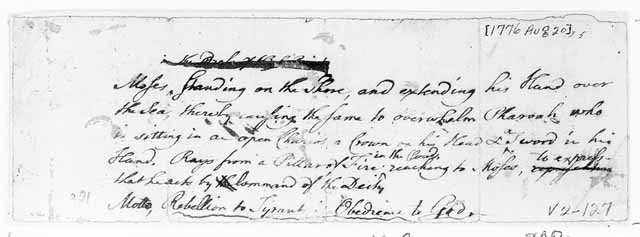
Handwritten 1776 description of the proposed Exodus seal
A surviving 1776 Exodus proposal · Library of Congress. A written proposal, never an adopted seal. Examine the manuscript record (opens in a new tab)

01 · The documentary chain

From shared story
to shared responsibility.

Choose a connection, or expand the full sequence. Each record keeps its writer, date, purpose and source.

Private letter · contemporary transcription

“He fill’d and swell’d the Bosom of every Hearer.”

Adams describes George Duffield applying Isaiah 35 to America: a wilderness becoming a place of renewal. He then describes a continental fast bringing people into simultaneous prayer. The letter records how a shared biblical story could animate listeners and accompany coordinated public observance.

What this establishes

The observable connection is between a common story, emotional response and shared action. This letter records Adams’s experience; it does not measure a supernatural mechanism or every listener’s belief.

02 · A passage worth reading closely

Franklin actually wrote
“thirteen tribes.”

In his April 8, 1788 ratification essay, Franklin uses this formulation while comparing resistance to Moses’s government with resistance to the proposed federal Constitution.

The scholarly edition traces the essay to a manuscript in Franklin’s handwriting, its Philadelphia publication and his later acknowledgment of authorship. That establishes a direct founding-era Israel–America analogy.

03 · Babylon’s interpretive view

The twelve.
The presence at the center.

Babylon reads Exodus as a movement toward an integrated people and an integrated inner life. This teaching comparison sits beside the historical record; it is not attributed to the founders.

INDWELLING PRESENCEShekinah

Orientation · relationship · shared responsibility

Babylon · heart chamber 1 of 12

ה

Hey
The Face

Explore this chamber as one part of a whole. A complete person has room for all twelve functions; this diagram does not assign a chamber to a founder or a tribe.

The twelve heart chambers remain distinct from the ten Tree stations and twenty-two letter paths.

Explore Babylon’s heart teaching (opens in a new tab)

What supports the center image?

Exodus 25:8 describes divine dwelling among the people. Numbers 2 orders the tribal divisions around the Tent of Meeting. Exodus 40:34–38 describes glory filling the sanctuary and the cloud guiding movement. Babylon brings these passages into a reading of the twelve oriented around indwelling presence. “The thirteenth” is an interpretive description here, not a number assigned to that presence in these passages.

04 · Follow each textual witness

The twelve across
passage, heart and sky.

These sources support different parts of the comparison. Later commentary, ancient cosmic interpretation and a founder’s letter are different kinds of witnesses.

Later Jewish interpretation

Twelve paths

Pirkei DeRabbi Eliezer 42:5 describes paths through the sea corresponding to the tribes, with the people able to see one another. Exodus itself does not explicitly enumerate twelve crossing paths.

Read this witness (opens in a new tab)

Exodus 15:27 · Rashi and Mechilta

Twelve springs

Elim’s twelve springs follow the sea crossing and Marah’s bitter waters. Rashi connects the springs to the twelve tribes.

Read this witness (opens in a new tab)

Exodus 24:4

Twelve pillars

Moses erects twelve pillars representing the tribes at the covenant ceremony. The people’s distinct identities enter a shared undertaking.

Read this witness (opens in a new tab)

Numbers 2

Four sides around a center

Twelve tribal divisions are arranged in four groups of three around the Tent of Meeting. The Levites’ service is distinguished from the surrounding divisions.

Read this witness (opens in a new tab)

Josephus · Antiquities 3.186

An ancient cosmic reading

Josephus explicitly interprets the twelve breastplate stones through the twelve months or zodiac signs. His interpretation supplies an ancient connection between tribal symbolism and the annual sky.

Read this witness (opens in a new tab)

Sefer Yetzirah · Gra version, chapter 5

Letters, sky, year and living being

The twelve simple letters correspond across the world, the year and the living being. This is a separate textual witness for comparing sky, time and embodied life, rather than a statement by the American founders.

Read this witness (opens in a new tab)

05 · Carry the promise forward

Ask whose freedom
the new order protected.

The founders’ language of deliverance belongs beside the founding’s exclusions. The original Constitution protected slavery through provisions concerning representation, the slave trade and the return of people held to service. Article VI also prohibited religious tests for federal office. Following both the promises and the enacted rules keeps the story accountable.

Phillis Wheatley’s 1774 letter to Samson Occom applies Israel’s Egyptian bondage to Black freedom. Her contemporary voice asks the same Exodus question from the position of those denied liberty.

Continue the connected story

Read the image.
Hear the words. Follow the choice.

Explore the original sealsRead the correspondenceListen to the ConstitutionExplore Babylon Seasons

Documentary connections reviewed November 10, 2026. The records document historical uses of Exodus and covenant; Babylon’s creation reading is presented as its authored interpretation.